
10 Secrets VCs Won’t Tell You About Raising Funding
Raising funding is the milestone every founder chases — but the real rules of raising funding are ones VCs rarely say out loud. In this guide, Rise of Startups breaks down the 10 most important secrets about raising funding that experienced investors know but almost never share: from what they actually judge in a pitch room, to how to negotiate a term sheet without giving away control, to why milestone-based funding is becoming the new standard. If you are raising funding for your startup in 2026, these are the insights that separate founders who close rounds from those who keep getting polite rejections.
10 VC Secrets Every Founder Raising Funding Must Know
Funding & VC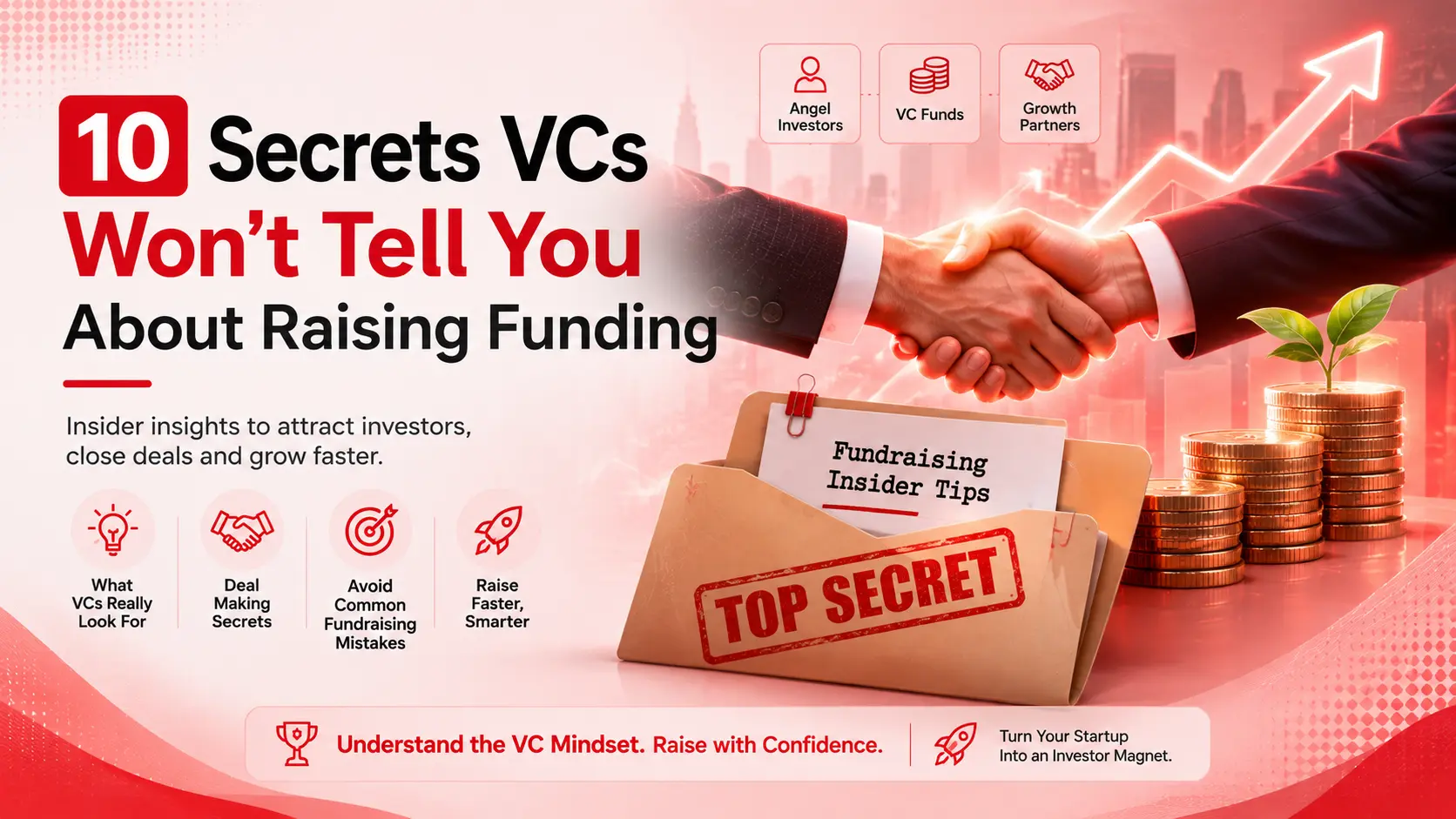
- →VCs invest in founders first — clarity, resilience, and execution ability matter more than the slide deck when raising funding
- →Real traction — paying customers, week-over-week growth — tells a stronger story than any five-year projection
- →A term sheet is the beginning of a negotiation, not the end — liquidation preferences and board seats define your future
- →Milestone-based funding aligns incentives — you prove progress, they release capital — and is increasingly standard in 2026
- →Raising funding is a learnable skill — every meeting is practice that compounds toward the close
“Every founder wants capital. The truth about winning it lies in quiet rules of risk, numbers, and how you perform under pressure — not in the pitch deck.”
The path to raising funding rarely follows the neat script. VCs judge by people, numbers, and the choices you make when things get hard. Most founders walk into the process knowing the theory — traction matters, unit economics matter, narrative matters. But the specific, unspoken rules that actually govern how investors make decisions? Those stay largely behind closed doors.
This guide opens those doors. The 10 secrets below are what experienced investors know about raising funding that they almost never share directly with founders — because nobody taught them to, because it complicates their deal flow, or simply because they assume founders already know. Most do not. After reading this, you will.
The 10 Secrets VCs Know About Raising Funding
The 10 most important secrets about raising funding that VCs rarely share are: (1) they back founders not ideas; (2) real traction beats projections; (3) unit economics are non-negotiable; (4) capital efficiency is now required; (5) a term sheet is a negotiation not a celebration; (6) investors need a clear exit story; (7) your pitch must reduce doubt not inflate hope; (8) targeted outreach beats volume; (9) milestone-based funding aligns incentives; and (10) raising funding is a learnable skill that compounds with practice.
VCs Back the Founder — Not the Idea
The first truth investors won’t tell you is that the business idea is almost secondary in the early rounds. Investors hire founders. What they are evaluating in the first meeting is your clarity under pressure, your intellectual honesty about what you do not know, and your demonstrated ability to execute. A mediocre idea executed brilliantly beats a brilliant idea executed poorly — every time. Before you obsess over your deck, obsess over how you communicate under hard questions.
Real Traction Beats Complex Forecasts Every Time
Five-year revenue projections in a pitch deck are largely ignored. What experienced investors look for when evaluating a fundraising pitch is real, verifiable traction: week-over-week growth in revenue or active users, paying customers (even just 5), and retention data that shows people are coming back. One paying customer who returns every month is more persuasive than a $100M revenue model in year five. Traction de-risks the investment in a way that no slide can replicate.
Unit Economics Can Make or Break Your Investor Pitch
If you cannot explain your CAC, LTV, payback period, and gross margin clearly and without jargon, no vision statement will save your funding pitch. These numbers tell investors whether the business is structurally sound or structurally broken. Founders who know their unit economics deeply — even at an early stage with imperfect data — consistently get further in the process than those who wave their hands at the financial slide. Know your numbers. Know where the assumptions are. Own the uncertainty.
The Market Wants Capital Efficiency — Not Blind Growth
The era of growth-at-all-costs is over. Investors evaluating startups in 2026 are explicitly evaluating how efficiently a startup converts capital into revenue. You do not need to be profitable yet — but you need a credible, specific path to margin expansion. The startups getting funded right now are the ones that show they can grow without proportionally increasing burn. Efficiency is no longer a constraint; it is a feature.
A Term Sheet Is Not a Celebration — It Is a Negotiation
This is the secret that costs founders the most money. When a VC issues a term sheet during the fundraising process, it is easy to feel like the hard part is over. It is not. The terms inside that document — liquidation preferences, board composition, anti-dilution clauses, voting rights, and founder vesting — will govern your relationship with that investor for the life of the company. Read every line. Hire a startup lawyer who has reviewed at least 10 VC term sheets. Negotiate. A slightly lower valuation with founder-friendly terms is consistently worth more than a higher number with punishing governance clauses.
Investors Need a Clear Exit Story Before They Commit
VCs raise funds from limited partners who expect returns within 7–10 years. So when they evaluate your pitch, they are simultaneously evaluating whether there is a realistic path to a return — an IPO, an acquisition, or a secondary. You do not need a guaranteed exit plan. But you do need to have thought about who the natural acquirers in your space are, what recent comparable acquisitions have happened, and what the realistic multiple looks like. Founders who can speak to this fluently remove a significant mental blocker for investors.
Your Narrative Must Reduce Doubt — Not Just Inflate Hope
Most pitch decks are built to inspire. The best pitch decks are built to reduce the specific doubts that are running in the investor’s head while you present. The three questions every investor is silently asking during any investor pitch: How will you actually acquire customers at scale? What makes this defensible when a well-funded competitor copies it? Why is this the right moment in history for this idea? Answer these three questions directly and specifically — and your narrative will stand apart from 90% of the pitches that investor hears that week.
Targeting the Right Investors Matters More Than Volume
The standard advice to “talk to as many investors as possible” is wrong. A broad, untargeted approach creates the impression of desperation, wastes your most valuable asset (time), and results in feedback from investors who were never going to fund you anyway. The right approach is to identify 10–15 investors who actively fund startups in your specific sector and stage, pursue warm introductions to each, and run a focused, structured process. Five deeply qualified meetings will consistently outperform fifty cold outreaches.
Milestone-Based Funding Creates Fairness for Both Sides
Tranche-based or milestone-based funding — where capital is released in stages as pre-agreed milestones are hit — is increasingly standard in 2026, particularly in emerging markets. For founders raising funding, this structure means you access capital as you prove performance rather than spending all of it upfront. For investors, it reduces the risk of deploying a full round into an unproven team. When structured well, milestone-based tranches align incentives, maintain founder accountability, and reduce the tension that often builds between investors and founders in the 12 months post-close.
Raising Funding Is a Learnable Skill — Not a Talent
The final and most important secret: fundraising is a skill that every founder can improve with deliberate practice. The founders who close rounds are not the naturally charismatic ones — they are the ones who have rehearsed every objection, know their walk-away numbers, treat every meeting as useful data, and keep improving the pitch based on patterns in what investors push back on. Start the process earlier than feels necessary. Take every meeting you can get, even from investors who are not a fit. The skill compounds — and the close comes when you are sharp enough to earn it.
Your Raising Funding Readiness Checklist
Before approaching a single investor, run through every item below. Each unchecked box is a reason to wait — and a signal of where to focus your preparation energy:
Milestone-Based Funding: How It Works in 2026
Milestone-based funding structures the investment in tranches — each tranche is released when the startup hits a pre-agreed business milestone. This approach to startup fundraising aligns investor and founder incentives, reduces deployment risk, and is increasingly standard in seed and pre-Series A rounds globally in 2026.
| Tranche | Capital Released | Milestone Required | Typical Timeline |
|---|---|---|---|
| Tranche 1 | 40–50% of round | Signed term sheet + legal close | At close |
| Tranche 2 | 30–35% of round | Hit agreed MRR target or user milestone | Month 4–6 |
| Tranche 3 | 15–30% of round | Retention rate + next hire milestone | Month 8–12 |
Why Predictability Beats Excitement When Raising Funding
The founders who consistently close rounds are not the most charismatic people in the room. They are the most predictable — in the best sense of the word. Their metrics move in the direction they said they would. Their team executes what the pitch deck promised. Their monthly investor updates arrive on the first of the month, every month.
Investors choose the founder who reduces their risk — not the one with the most inspiring vision. Clarity consistently beats charisma in every investor meeting. The investor who writes the cheque is making a bet that you will do what you say, when you say it, and that you will tell them the truth when something goes wrong. Build every interaction around that expectation and you will close faster than founders with bigger ideas and messier execution.
Frequently Asked Questions About Raising Funding
Raising funding is not a lottery. It is a process — one that rewards preparation, targeting, honesty, and persistence in equal measure. The 10 secrets above are not shortcuts. They are the foundation of how experienced founders approach every fundraising cycle: with clear numbers, a targeted investor list, a pitch that reduces doubt, and the patience to treat every meeting as practice.
The founders who consistently close rounds are not the most exciting ones in the room. They are the most prepared, the most honest about what they don’t know, and the most relentless about improving after every rejection. Raising funding at its core is a skill — and like every skill, it compounds with deliberate practice.
Start your fundraising process earlier than feels comfortable. Build the relationships before you need the capital. Know your numbers cold. And when the term sheet comes, read every line before you celebrate.
For your complete playbook: 7 Venture Capital Moves for New Ventures · Secrets of Startup Funding Every Founder Must Know.