Smart Startup Growth Strategies Every Founder Must Know
Smart startup growth strategies are what separate founders who scale from those who burn runway chasing tactics that never compound. In this guide, Rise of Startups breaks down 9 proven smart startup growth strategies — from picking the right growth model to building a data-driven growth culture — along with a practical 30-60-90 day checklist and real-world examples every founder can act on today.
9 Smart Startup Growth Strategies Every Founder Must Know
Growth & Marketing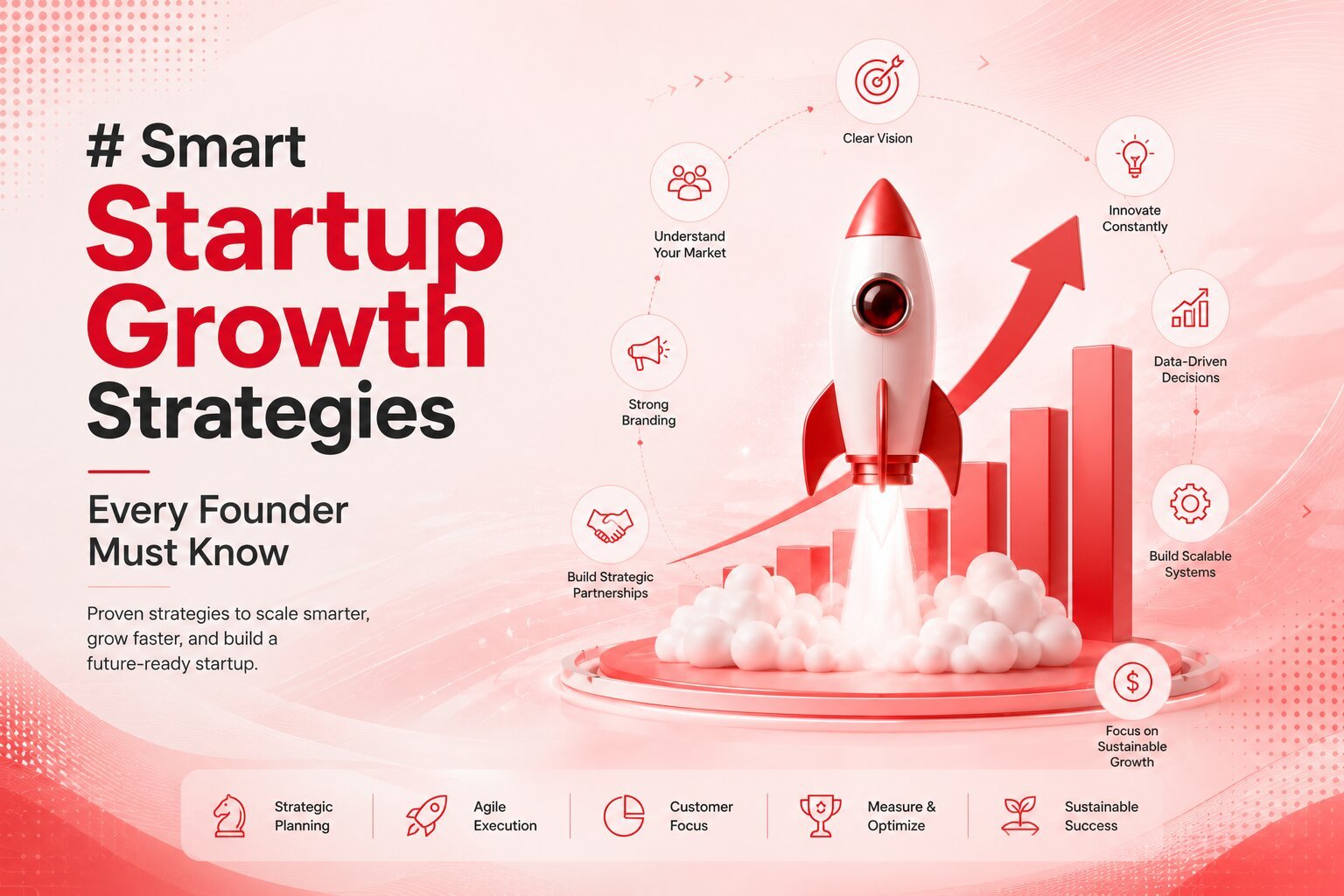
- →If your LTV is not at least 3x your CAC, fix the product before you scale — not after
- →One channel mastered beats five channels tested — repeatability is more valuable than reach
- →Retention is cheaper than acquisition — reducing churn by 5% can lift revenue by 25–95%
- →Product-led growth works when the product delivers value before the user speaks to a salesperson
- →A growth culture — weekly KPI reviews, data-driven decisions, celebrating learnings — compounds faster than any tactic
“Growing a startup is like steering a small boat into open sea. One good wind helps, but smart navigation makes the difference.”
Most founders chase customers without a clear plan. They run ads, post content, and hire salespeople hoping something sticks. The result: burned runway, rising CAC, and a team that’s constantly reactive instead of compounding. Without smart startup growth strategies, even strong products fail to scale.
The difference between startups that scale and those that stall is not effort — it’s clarity. The 9 smart startup growth strategies in this guide give you a focused framework to reduce churn, lower customer acquisition costs, and build revenue that grows predictably. Every strategy is tested, every step is actionable, and the 30-60-90 day checklist at the end tells you exactly what to do next.
The 9 Steps to Scale with Confidence
The 9 most effective smart startup growth strategies are: (1) validating your growth model against LTV:CAC, (2) mastering one acquisition channel, (3) building a clear conversion funnel, (4) implementing product-led growth, (5) forming strategic partnerships, (6) running structured experiments, (7) prioritising retention, (8) optimising monetisation, and (9) building a data-driven growth culture. These smart startup growth strategies work across B2B SaaS, consumer apps, and marketplace businesses.
Product-market fit is non-negotiable. If LTV is not at least 3x your CAC, improve the product first — not the marketing. Understand whether you are a sales-led, marketing-led, or product-led business before choosing tactics.
- Run a short paid pilot with 10–20 target customers
- Conduct structured user interviews — ask about their top 3 frustrations
- Track trial-to-paid conversion weekly, not monthly
Trying five channels at once means you are learning nothing deeply. Pick one strong channel and refine it until you have a repeatable, predictable process. Then add a second channel.
- SEO for long-term, compounding inbound growth
- Paid ads only once your unit economics are stable
- Referral programs when NPS is above 40 and users genuinely love the product
Create a simple path: Attract → Engage → Convert → Delight. Identify the single biggest drop-off point and fix that step before touching anything else.
- Track micro-conversions (email signup → trial, trial → first action)
- Measure time-to-first-value: how fast does a new user reach their “aha moment”?
- Reduce wasted ad spend by only scaling traffic after funnel leaks are fixed
Product-led growth (PLG) lets the product acquire, convert, and retain users without relying on a sales team. This reduces friction and creates organic expansion through usage.
- Freemium plans that deliver real value before the paywall
- Sharing and collaboration features built directly into the product
- In-app nudges that guide users toward the highest-value actions
Partner with companies already serving your target audience. You gain instant trust, reach, and warm traffic that converts at significantly higher rates than cold acquisition.
- Identify 5 complementary businesses with shared ICPs but no competing products
- Run joint webinars or co-authored content to leverage both audiences
- Build formal integration partnerships if you are a SaaS product
Disciplined testing makes growth predictable. Without structure, you confuse correlation with causation and waste months on tactics that never scale.
- Write a clear hypothesis before every test: “If we change X, we expect Y because Z”
- Launch fast and cheap — a $500 test gives 80% of the learning of a $5,000 test
- Keep or kill based on data, not gut feel or sunk cost
Acquiring new customers is expensive. If current customers leave, you are pouring water into a leaking bucket. A 5% improvement in retention can increase revenue by 25–95% according to Bain research.
- Streamline onboarding — users who reach the “aha moment” within 24 hours churn at half the rate
- Build personalised email sequences triggered by in-app behaviour, not just time
- Track cohort retention weekly — spot drop-off patterns before they compound
Small pricing changes can significantly lift revenue and LTV without changing the product. Most early-stage startups undercharge because they fear losing customers — but underpricing signals low value.
- Test 3-tier pricing (Good, Better, Best) — the middle tier drives 60–70% of conversions
- Offer annual billing with a 20–30% discount — instantly boosts LTV and reduces churn
- Align price to the value metric your customers actually care about
Tactics are temporary. Culture compounds. A team that values experiments, runs weekly reviews, and celebrates learnings — even from failures — consistently outperforms teams chasing whatever worked for their competitors.
- Hire or appoint a Growth Lead who sits across Product and Marketing
- Run weekly 30-minute KPI reviews — not just monthly reports
- Celebrate a failed experiment that generated a clear insight as much as a win
Why These Strategies Matter: The Numbers

Your 30-60-90 Day Growth Checklist
When implementing smart startup growth strategies, use this 30-60-90 day checklist: validate your value proposition and select one acquisition channel in the first 30 days; run five structured experiments and build funnel tracking at 60 days; double down on what worked and add a referral or partnership channel by day 90. This framework is the fastest way to turn smart startup growth strategies into repeatable, measurable results.
- ✅Validate value: Confirm a real, specific customer need through 10+ interviews
- ✅Choose one channel: Select ONE primary acquisition channel and commit to it for 60 days minimum
- ✅Baseline metrics: Set up tracking for CAC, LTV, trial-to-paid conversion, and weekly active users
- ✅5 experiments: Run at least 5 structured growth tests with a clear hypothesis for each
- ✅Funnel tracking: Build basic funnel visibility — identify where users drop off and why
- ✅Retention audit: Interview every churned customer and find the most common reason they left
- ✅Double down: Put 80% of resources into the channel or experiment that performed best
- ✅Add referrals or partnerships: Introduce a second channel once the first is repeatable
- ✅LTV check: If LTV:CAC is above 3:1, begin scaling paid acquisition
- ❌Avoid: Adding a third channel before the second is profitable
Real-World Startup Growth Examples
The strategies above are not theoretical. Here is how fast-growing startups have applied them to generate compounding results:
box
Dropbox — Referral Program
Dropbox built virality directly into the product: refer a friend, both users get extra storage. This single mechanic grew their user base from 100,000 to 4 million in 15 months — a 3,900% increase — with near-zero paid acquisition cost. The key: the reward was more of the core product, not a discount or cash.
pot
HubSpot — Content-Led Growth
HubSpot bet everything on one channel — SEO-driven content — before expanding. By mastering one channel deeply, they built a content engine that now generates millions of monthly visitors and hundreds of thousands of inbound leads without scaling paid spend proportionally.
PLG
Early-Stage SaaS — Paid Pilots
Many early-stage B2B SaaS startups globally run paid pilots with 10–20 target customers before public launch. This generates paying revenue, real case studies, and product feedback simultaneously — dramatically reducing churn when they open to the wider market because the product has already been refined against real usage.
Frequently Asked Questions
Smart startup growth strategies are not about trying everything — they are about choosing the right things in the right order and executing them with discipline. The best smart startup growth strategies share one trait: they compound. Validate your growth model before scaling. Master one channel before adding a second. Fix retention before pouring money into acquisition.
The 30-60-90 day checklist above gives you a concrete sequence to follow. The nine strategies give you the toolkit. What you do with them this week is the only variable that matters.
Choose one strategy from above and run one small test on it this week. Keep the budget small, measure the outcome precisely, and let the data decide what happens next. That is how every great startup growth engine starts — not with a big bet, but with a repeatable process.
For founders also thinking about funding alongside growth, see our complete guide: 10 Secrets VCs Won’t Tell You About Raising Funding.